
Physics A Level | Chapter 15: Atomic structure 15.3 A simple model of the atom
After Rutherford had presented his findings, the nuclear model of the atom gained rapid acceptance. This was partly because it helped chemists to explain the phenomenon of chemical bonding (the way in which atoms bond together to form molecules). Subsequently, the proton was discovered. It had a positive charge, equal and opposite to that of the electron. However, its mass was too small to account for the entire mass of the atom and it was not until the early $1930s$ that this puzzle was solved by the discovery of the neutron, an uncharged particle with a similar mass to that of the proton. This suggests a model for the atom like the one shown in Figure 15.6:
- Protons and neutrons make up the nucleus of the atom.
- The electrons move around the nucleus in a cloud, some closer to and some further from the centre of the nucleus.
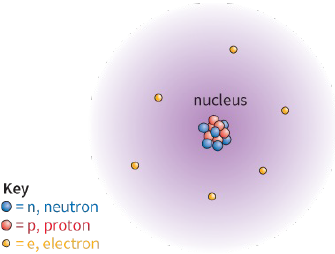
From this model it looks as though all matter, including ourselves, is mostly empty space. For example, if we scaled up the hydrogen atom so that the nucleus was the size of a $1 cm$ diameter marble, the orbiting electron would be a grain of sand about $800 m$ away!
From this model it looks as though all matter, including ourselves, is mostly empty space. For example, if we scaled up the hydrogen atom so that the nucleus was the size of a $1 cm$ diameter marble, the orbiting electron would be a grain of sand about $800 m$ away!
The scale of things
It is useful to have an idea of the approximate sizes of typical particles:
- radius of proton $ \sim $ radius of neutron $ \sim {10^{ - 15}}m$
- radius of nucleus $ \sim {10^{ - 15}}m$ to ${10^{ - 114}}m$
- radius of atom $ \sim {10^{ - 10}}m$
size of molecule $ \sim {10^{ - 10}}m$ to ${10^{ - 6}}m$.
(Some molecules, such as large protein molecules, are very large indeed – compared to an atom!)
The radii of nuclear particles are often quoted in femtometres (fm), where $1\,fm = {10^{ - 15}}m$.
Nuclear density
We can picture a proton as a small, positively charged sphere. Knowing its mass and radius, we can calculate its density:
$mass\,of\,proton\,{m_p} = 1.67 \times {10^{27}}\,kg$
$radius\,of\,proton\,r\, = 0.80\,fm\, = \,0.80 \times {10^{ - 15}}\,m$
(In fact, the radius of the proton is not very accurately known; it is probably between $0.80 \times {10^{ - 15}}\,m$ and $0.86 \times {10^{ - 15}}\,m$.)
$\begin{array}{l}
volume\,of\,proton = \frac{4}{3}\pi {r^3}\\
= \frac{4}{3}\pi \times {(0.80 \times {10^{ - 15}})^3}\\
= 2.14 \times {10^{ - 45}}{m^3}\\
density = \frac{{mass}}{{volume}}\\
= \frac{{1.67 \times {{10}^{ - 27}}}}{{2.14 \times {{10}^{ - 45}}}}\\
\approx 7.8 \times {10^{17}}\,kg\,{m^{ - 3}}
\end{array}$
So the proton has a density of roughly ${10^{18}}\,kg\,{m^{ - 3}}$. This is also the density of a neutron, and of an atomic nucleus, because nuclei are made of protons and neutrons held closely together.
Compare the density of nuclear material with that of water whose density is $1000\,kg\,{m^{ - 3}}$ – the nucleus is 1015 times as dense. Nuclear matter the size of a tiny grain of sand would have a mass of about a million tonnes! This is a consequence of the fact that the nucleus occupies only a tiny fraction of the volume of an atom. The remainder is occupied by the cloud of orbiting electrons whose mass makes up less than onethousandth of the atomic mass.
Question
3) Gold has a density of $700\,kg\,{m^{ - 3}}$. A mass of $193 g$ of gold contains $6.02 \times {10^{23}}$ atoms. Use this information to estimate the volume of a gold atom, and hence its radius. State any assumptions you make.